
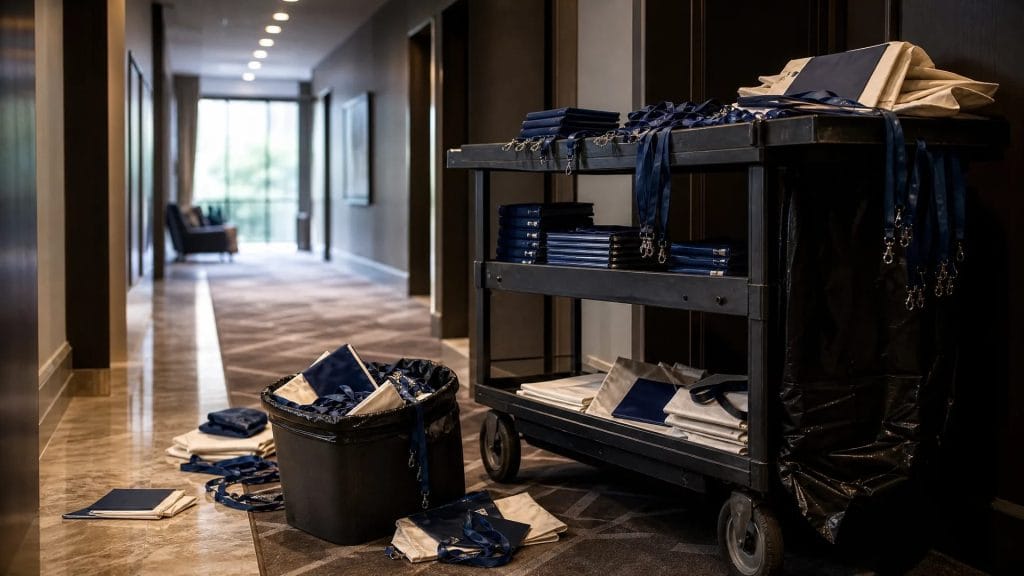
Walk down any hotel corridor after a conference wraps, and you’ll see the same thing: branded notepads on the cleaning trolley, lanyards in the bin, tote bags left behind with the programme still folded inside. It’s a familiar, expensive problem for anyone planning branded merchandise for corporate conferences. The spend was real. The impact wasn’t.
Why Most Conference Swag Ends Up in the Bin
The issue usually isn’t budget. It’s strategy, or the lack of one. Most conference merchandise gets chosen as an afterthought. Someone orders it in bulk and hands it out with no thought to when or how a delegate will actually use it.
The generic giveaway trap
Generic giveaways fail because they’re generic. A plastic pen with a logo doesn’t say anything about your brand. It doesn’t compete for space in a delegate’s bag next to their phone charger and conference notes. Delegates keep what’s useful, well-made, or genuinely delightful. Everything else gets left behind.
The fix isn’t more merchandise. It’s better-timed merchandise. Think of a conference in three distinct moments: before delegates arrive, while they’re in the room, and after they’ve flown home. Each moment calls for a different kind of item, chosen for a different job. That’s the three-stage model below, and it’s the difference between merchandise that gets used and merchandise that gets left on a hotel pillow.
The Three-Stage Framework for Corporate Conference Merchandise Strategy
A useful corporate event merchandise strategy treats the conference as a timeline, not a single moment. Pre-event items build anticipation. In-room items earn attention during the sessions themselves. Post-event items carry your brand home, and that’s where most of the real ROI lives.
Pre-event: building anticipation
Merchandise can start doing work before delegates even arrive. A branded pre-arrival gift, mailed ahead of a summit or sent as part of a digital invite follow-up, signals that the event is worth clearing a diary for. Subtlety matters more than volume here: one well-chosen item, tied to the event theme, does more than a box of assorted freebies.
For South African comms teams working across multiple cities or hybrid formats, pre-event merchandise also solves a logistics problem. Delegates travelling in from Durban, Cape Town, or Gauteng often appreciate receiving something useful before they even pack a bag, rather than one more thing to carry home.
In-room: delegate pack curation that earns a second look
The delegate pack is the single highest-stakes merchandise decision in the whole event. Delegates open it at registration, in front of other delegates, often while queuing for coffee. What’s inside says something about how the host brand thinks.
A delegate pack that pairs a premium branded notebook with a quality water bottle tends to outlast a pack stuffed with low-cost trinkets. Fewer, better items signal that a brand values the delegate’s time. This is the core lesson for anyone building branded delegate gifts: quantity reads as filler, while a tightly curated pack reads as intention.
Think about what belongs in a delegate pack for a corporate conference: a notebook or journal for note-taking during sessions, a reusable bottle or mug for the day, a branded bag sturdy enough to carry take-home materials, and one “hero” item tied to the theme of the event. Skip the extras that exist only to bulk out the box. If you want a deeper look at how bag choice specifically affects pack quality, it’s worth exploring branded conference bags as a category on its own, since the bag is often the first item a delegate judges.
For a broader view of how this pack-first thinking extends across other event types, see this guide to strategic branded merchandise for corporate events.
Matching Merchandise to Conference Format and Delegate Seniority
Not every conference calls for the same merchandise. A leadership summit and a half-day training workshop have different audiences, different energy, and different expectations. The merchandise strategy needs to shift too.
Summits and executive audiences vs. workshops and training sessions
Executive summits reward restraint. Senior delegates respond to fewer, higher-quality items: a leather-bound journal, a premium travel mug, or a well-made charging accessory. These branded products for corporate summits should feel considered rather than promotional, closer to a gift than a giveaway.
Workshops and training sessions work differently. Delegates are there to learn, take notes, and move around, so merchandise for corporate workshops should lean practical: notepads, branded pens that actually write well, reusable cups for the tea station, and simple tote bags for handouts. The goal here isn’t luxury. It’s usefulness that reinforces the day’s content.
Getting this match right also applies to what delegates wear. A deeper look at branded apparel for corporate events is a useful next step if uniforms, polos, or event-branded jackets are part of your plan, since apparel choices shift just as much by seniority and format as drinkware or bags do.
Practical, Daily-Use Items That Keep Your Brand Top of Mind
Once the event ends, the merchandise that survives is the merchandise that earns a place in someone’s daily routine. Promotional products research has long shown that recipients keep useful branded items such as bags, drinkware, and apparel for months after an event, far outlasting printed collateral.
That’s the logic behind good conference giveaway ideas in South Africa right now: drinkware that replaces a disposable coffee cup, tech accessories like power banks and cable organisers that solve a real everyday problem, and bags built to be reused rather than binned after one trip home. These are the items that keep working long after the last session ends, quietly reinforcing the brand every time someone uses them.
Eco-conscious choices for sustainability-aware audiences
South African corporates increasingly ask for recycled or reusable conference merchandise, from cotton tote bags to bamboo tech accessories. That reflects a broader shift toward sustainability-aware procurement. This isn’t just a nice-to-have anymore. For many procurement teams and ESG-conscious clients, it’s becoming a baseline expectation.
Choosing eco-friendly promotional products for conferences also gives comms teams a talking point of their own, a way to show delegates that the brand’s values extend past the stage banner. If sustainability is part of your brand story, it’s worth reading more on eco-friendly promotional products in South Africa before finalising a delegate pack.
Customisation Depth: Full-Colour Print vs. Subtle Embossing
How you brand an item says almost as much as what the item is. Full-colour print is bold, visible, and reads well across a crowded exhibition hall or registration desk. It’s the right call for mass-distribution items where visibility during the event matters most: lanyards, tote bags, water bottles handed out at scale.
Embossing or debossing works differently. A subtle, tonal mark on leather, wood, or a premium notebook cover signals restraint and quality rather than shouting the logo. This is the right register for branded merchandise for summit events and executive gifting, where the goal is to make the recipient feel chosen, not marketed to.
The rule of thumb: match customisation depth to the message you want the item to send. Loud branding for reach. Quiet branding for status. Get this mismatched, full-colour print on an executive gift, or a barely-visible emboss on a mass giveaway, and it undercuts the strategy even when the underlying product is good.
Sourcing Timelines and Turning Conference Merchandise into Measurable ROI
Even the best-planned merchandise strategy falls apart if the timeline doesn’t work. South African sourcing and branding lead times vary by product complexity, order volume, and whether stock needs importing, so building in buffer time protects the whole plan.
Planning lead times in South Africa
As a general rule, suppliers can source and brand simple items such as pens or notepads faster than complex or imported goods like tech accessories or premium apparel. Custom conference merchandise with specific colours, packaging, or multi-item kitting needs even more lead time to allow for sampling and approval.
The safest approach is to start sourcing conversations as soon as the conference date and delegate numbers are confirmed, rather than waiting until the final agenda is locked. For a detailed breakdown of what to expect at each stage, this guide to branded merchandise turnaround time is a useful planning reference before you brief a conference merchandise supplier in South Africa.
Tracking recall and engagement after the event
Merchandise spend is easier to justify to stakeholders when it’s tied to a measurable outcome, not just a line item on an event budget. A few simple, low-effort ways to track this: monitor redemption rates if items are collected from a branded stand rather than pre-packed; track social mentions or tagged photos of delegates using branded items during and after the event; and follow up with a short post-event survey asking which items delegates kept and used.
Repeat use is the strongest signal of all. If a branded bottle or bag shows up again at a different meeting or on a delegate’s desk weeks later, that’s real brand mileage, the kind printed collateral simply can’t deliver. For more detail on connecting these signals back to budget conversations, see this piece on branded merchandise that drives lasting event ROI.
If your conference sits alongside other event formats on the calendar, it’s also worth comparing notes with a trade show merchandise strategy, since audience behaviour, and therefore the right merchandise mix, shifts noticeably between a seated conference and a walk-through exhibition floor.
Planning Your Next Conference Merchandise Strategy
The best branded merchandise for corporate conferences in South Africa isn’t the item with the biggest logo or the lowest unit price. It’s the item chosen for a specific stage of the delegate’s experience, made well enough to survive the trip home, and branded in a way that matches the audience in the room.
MerchGuru’s done-for-you sourcing service pairs creative strategy with product sourcing across drinkware, apparel, tech, bags, and homeware, so conference merchandise gets planned as a storytelling tool rather than a last-minute purchase. That thinking draws on Abstract7 Creative Media Solutions, which brings over 25 years of branding and communications experience to how each merchandise category gets framed around the outcome it delivers for a brand.
If you’re planning delegate packs, summit gifts, or workshop giveaways for an upcoming conference, it’s worth mapping the strategy before you order stock. Get in touch with MerchGuru for a strategy consultation or custom quote, and turn your next conference into merchandise delegates actually keep.