
Choosing eco-friendly promotional products South Africa suppliers used to feel like a niche decision. In 2026, it’s a core brand strategy call. Clients notice what you give them, employees notice what you stand behind, and procurement teams are asking harder questions than ever about where branded merchandise comes from and what happens to it afterwards. If your gifting programme can’t answer those questions confidently, it’s quietly working against your brand.
This guide is built for SA marketing managers, brand custodians, and procurement leads who want to move beyond token sustainability, and build a gifting strategy that genuinely reflects their values.
Why Sustainable Corporate Gifts Are No Longer Optional
The shift South African brands are making in 2026
Green corporate gifting has crossed a threshold. It’s no longer a differentiator reserved for environmentally focused brands, it’s become a baseline credibility signal across sectors. South African corporates are increasingly aligning their gifting and procurement budgets with broader ESG commitments and B-BBEE social responsibility goals, which means sustainability has moved from the communications team’s desk to the CFO’s agenda.
Brands that treat gifting as a throwaway line item are finding that recipients notice. A branded item made from virgin plastic, shipped from the other side of the world in excessive packaging, tells a story, just not the one you want.
What your clients and employees actually expect
Recipients in 2026 are informed. They can spot a greenwashed product. Employees are vocal about wanting the brands they work for to walk the talk, and a well-chosen sustainable gift is one of the most tangible ways a company can show it does.
Clients are making similar assessments. Corporate gift ideas for employees in South Africa that align with a company’s stated values build trust far more effectively than high-spend gifts that contradict them. The bar has risen, and brands that clear it stand out.
What Makes a Promotional Product Truly Eco-Friendly?
Materials that matter: recycled, organic, and biodegradable
The word “eco-friendly” is doing a lot of heavy lifting across the promotional merchandise market. To cut through the noise, focus on materials with a clear, verifiable story:
- Recycled PET (RPET), made from post-consumer plastic bottles, it closes a loop on single-use plastic waste.
- Organic cotton, grown without synthetic pesticides or fertilisers, with certifications like GOTS (Global Organic Textile Standard) to back the claim.
- Bamboo, fast-growing and biodegradable, widely used in drinkware and stationery.
- Seed paper, embedded with indigenous plant seeds, it offers a genuinely zero-waste end-of-life story. SA brands running conservation-themed campaigns have found real creative traction with seed paper notepads, business cards, and swing tags.
- Biodegradable or compostable materials, packaging and product finishes that break down without leaving harmful residue.
Each of these has a traceable impact story. That’s what separates genuine eco credentials from vague claims.
Local sourcing vs. imported ‘greenwashing’
Here’s a red flag worth knowing: a product labelled “sustainable” that’s shipped from overseas through a long, opaque supply chain often has a larger carbon footprint than a conventional item sourced locally. The carbon miles matter.
For South African brands, local sourcing is a genuine competitive advantage. Shorter supply chains mean lower transport emissions, faster delivery, easier quality verification, and a direct contribution to local manufacturers and jobs, which carries its own B-BBEE narrative weight. When you source eco promotional products locally, you’re not just ticking a sustainability box; you’re investing in the SA economy.
Ask any supplier about country of manufacture, not just country of assembly. The distinction matters.
Top Eco-Friendly Promotional Product Categories for SA Brands
Reusable drinkware and food-safe alternatives
Reusable drinkware is the top-performing category for daily-use brand recall, and for good reason. A bamboo travel mug or RPET water bottle lands on a desk or in a gym bag and stays there. Every use is an impression.
The most effective gifting programmes pair reusable drinkware with a personalised impact card showing, for example, how many single-use plastic bottles the item replaces over a year. Brands using this approach consistently report stronger emotional recall from recipients than those who gift the product alone. The card turns a useful object into a shared value statement.
For client gifting and employee onboarding alike, drinkware with a clear sustainability story delivers both functional and emotional returns.
Organic cotton branded apparel and tote bags
Organic cotton branded apparel sits at the intersection of visibility and values. A well-designed organic cotton t-shirt or tote bag is worn, carried, and seen, giving your brand repeated exposure while signalling conscious sourcing to anyone who asks.
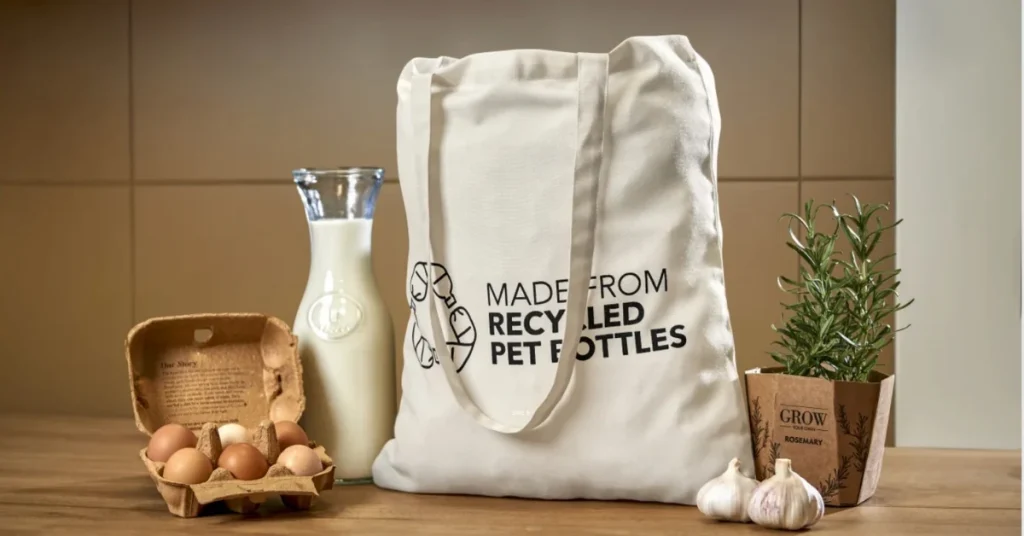
RPET tote bags are among MerchGuru’s most requested items in 2026, alongside organic cotton t-shirts and bamboo drinkware sets, all available with full custom branding and local delivery across South Africa. For events, these categories are particularly strong: they’re lightweight, high-impact, and easy to scale.
Tote bags made from recycled materials also perform well as zero-waste alternatives to single-use branded bags at conferences and trade shows.
Recycled promotional merchandise: tech and stationery
Recyclable promotional merchandise has expanded well beyond the obvious categories. Recycled PET notebooks, pens made from reclaimed ocean plastic, and tech accessories built from certified recycled materials are all now available at scale, and they carry a story that recipients actually talk about.
For client gifting programmes with a premium brief, a curated set of recycled-material stationery or a bamboo wireless charger communicates innovation and intention simultaneously. These are the kinds of gifts that earn a second look and a conversation.
Green Corporate Gifting Trends Shaping 2026 and Beyond
Four trends are defining where sustainable corporate gifts are heading. SA brands that act early will have a head start.
Eco-impact storytelling. The product is only half the gift. Leading brands are pairing sustainable merchandise with a card or QR code that shows the environmental impact of the item, trees saved, plastic diverted, water conserved. This transforms a useful gift into a brand narrative moment, and recipients remember it.
Circular gifting programmes. Some forward-thinking SA brands are building take-back or refill mechanisms into their gifting, offering to replace or upgrade items rather than simply adding to the pile. It’s a long-term play that deepens client relationships and reduces waste simultaneously.
Multi-use over single-use. Single-use branded items, pens, plastic bags, disposable packaging, are increasingly seen as brand liabilities rather than assets. The procurement shift is clear: multi-use, durable, daily-contact items now dominate sustainable gifting budgets because they deliver more impressions per rand and less guilt per recipient.
Locally certified sustainable products. As demand for eco-friendly promotional products grows across South Africa, brands are asking for local certifications and local production proof rather than accepting imported sustainability claims at face value. Expect this scrutiny to sharpen further as ESG reporting requirements evolve into 2027.
Backed by over 25 years of branding experience through Abstract7 Creative Media Solutions, MerchGuru treats every eco product as a brand story vehicle, where the material choice, the packaging, and the delivery message work together to signal your brand’s values, not just its logo.
How to Source Eco Promotional Products Locally in South Africa
Questions to ask your supplier
Before committing to a sustainable gifting order, put these questions to your supplier:
- Where is the product manufactured? Local production reduces carbon miles and supports the SA economy. Insist on a clear answer.
- What certifications apply to the materials? Look for GOTS for organic cotton, GRS (Global Recycled Standard) for recycled content, and FSC for paper and wood-based products.
- Can you provide material traceability? Reputable suppliers can trace recycled content back to its source. Vague answers here are a greenwashing signal.
- What is the packaging made from? Eco products shipped in virgin plastic packaging undermine the entire story.
- Do you offer carbon-offset or low-emission delivery options? For large-volume orders, this matters.
- What happens to the product at end of life? Biodegradable, recyclable, or take-back options all add to the gift’s sustainability credentials.
Building an eco gifting strategy, not just a product list
The best eco gifting programmes don’t start with a product catalogue, they start with a question: What do we want this gift to say about who we are?
That question shapes everything: the material, the message, the packaging, the timing, and the impact story you tell alongside it. A bamboo drinkware set gifted with a personalised note about your brand’s water conservation commitment lands very differently from the same product in a plain box.
This is the strategic difference between ticking a sustainability box and building genuine brand equity through gifting. Green corporate gifting in 2026 is moving in one direction, towards intention, traceability, and story. Brands that get there first earn the association.
MerchGuru specialises in exactly this: helping SA brands identify the eco-friendly promotional products South Africa’s market demands, then building a gifting strategy around a story worth telling.
Ready to move beyond the product list? Contact MerchGuru for a free eco gifting consultation, or browse the sustainable range online and let the team help you build a programme that reflects your brand’s values from the first impression to the last.