
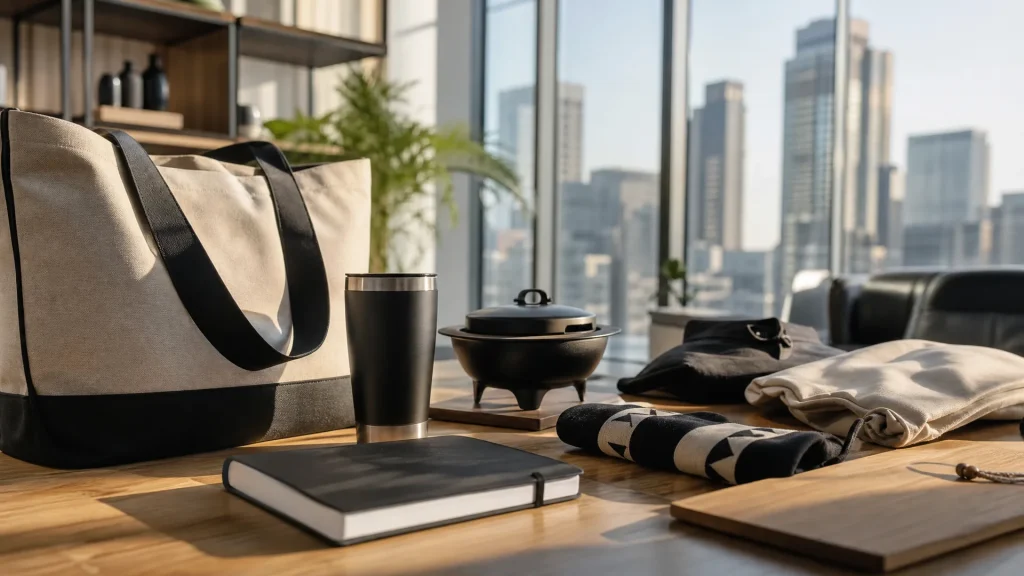
Most of the branded merchandise case studies South African marketers find online come from the US, UK, or Australia, markets with different buying power, different cultural cues, and different ideas of what a “great gift” looks like. That gap is a real problem. When local brand managers look for proof that promotional products actually work, they’re forced to apply foreign benchmarks to South African budgets, audiences, and contexts. This article changes that. Below, you’ll find a practical framework built from SA-contextualised campaign patterns, what the objective was, what product was chosen, how it was executed, and what it delivered. Use it as your local playbook.
Why South African Brands Need Their Own Merchandise Playbook
Global merch research is useful directionally. Promotional products industry data consistently shows that useful, high-quality branded items are kept for more than a year on average, meaning a single well-chosen piece can generate hundreds of brand impressions over its lifetime at a fraction of the cost-per-impression of paid media. But “useful” in Chicago looks different from “useful” in Johannesburg, Cape Town, or Durban.
South African brands operate across sharply different economic realities and cultural contexts, from enterprise corporate gifting in Sandton to community-level NGO activations in the Eastern Cape. Load-shedding shaped which tech accessories people actually value. Braai culture shapes what counts as a premium daily-use item. Township retail activations demand a different product logic than a CBD product launch.
Backed by over 25 years of branding and communications experience through Abstract7 Creative Media Solutions, MerchGuru’s positioning reflects a consistent insight: the brands that win with merchandise choose products their audience actually uses every day, not just items that look good in a catalogue photo.
That insight is simple. Applying it correctly, within SA budgets, to SA audiences, across SA sectors, is where local knowledge makes the difference.
Corporate Gifting Success Stories: Building Loyalty Through Branded Merchandise
The Premium Client Gift That Turned into a Brand Ambassador Moment
Objective: A mid-sized financial services firm wanted to shift its client perception from “competent supplier” to “trusted long-term partner” ahead of a contract renewal cycle.
Product choice: Instead of the usual branded pen-and-notepad combination, the team curated a gift set, a quality insulated tumbler, a leather-look notebook, and a branded desk organiser, all packaged in a rigid gift box with a handwritten card.
Execution: Gifts were hand-delivered by account managers during Q4 client visits, not posted. The delivery moment was intentional, it opened a natural conversation about the year ahead.
Outcome: A professional services firm that shifts from generic branded pens to a curated gift set consistently finds that recipients recall the brand months later, simply because the product earns daily desk space. The tumbler sits on the client’s desk every morning. The notebook travels to meetings. The brand stays in the room long after the visit ends.
The lesson: product quality and packaging signal how much you value the relationship. A well-chosen corporate gift isn’t about spend, it’s about relevance and intention.
Employee Recognition Campaigns That Moved the Needle on Culture
Objective: A Johannesburg-based tech company managing a distributed remote team wanted to reduce the “invisible employee” feeling that had emerged post-2020. Belonging scores on internal surveys were sliding.
Product choice: Branded homeware and apparel kits, a quality hoodie, a ceramic mug, and a branded notebook, delivered to each team member’s home address.
Execution: Kits arrived during the company’s annual virtual all-hands. Managers encouraged team members to wear the hoodie and use the mug on-camera during the session. The shared visual identity created a moment of collective belonging that a Slack message can’t replicate.
Outcome: Post-campaign pulse surveys showed a measurable lift in reported belonging and pride in the company brand. The apparel continued to generate organic social content, employees posting from home offices, coffee shops, and weekend runs, extending the campaign’s reach without additional media spend.
For corporate gift ideas that resonate with South African employees, the through-line is always the same: the product needs to fit naturally into the recipient’s actual life.
Event Merchandise Case Study: How Giveaways Create Long-Tail Brand Recall
Choosing Products That Outlive the Event
The standard conference tote filled with pens, stress balls, and a notepad is a familiar sight, and almost universally forgotten by the Monday after the event. SA brand activation examples that actually generate post-event recall share one trait: the product chosen is one the recipient would have bought for themselves.
At a major Johannesburg industry conference, an organiser replaced the standard tote-and-notepad bundle with branded insulated tumblers and USB hubs. Post-event social mentions of the brand spiked, and attendees were still using, and photographing, the items weeks later, extending the campaign’s organic reach well beyond the event floor.
The logic is straightforward. A quality insulated tumbler goes to the gym, the office, the school run. A USB hub sits on the desk and works daily. Both items keep the brand visible in contexts the original event never touched.
Measuring the ROI of Event Merchandise in South Africa
South African marketers often skip ROI measurement for merchandise because it feels hard to quantify. It doesn’t have to be. A simple cost-per-impression model works well as a proxy: take the total cost of the merchandise, estimate the number of times the item is used or seen over its useful life, and divide. A R150 tumbler used twice a day for a year generates roughly 700 individual brand impressions, a cost-per-impression that paid media rarely matches.
Beyond impressions, track these signals: post-event social mentions, inbound inquiries referencing the event, and anecdotal feedback from sales teams about clients mentioning the gift. None of these require a sophisticated measurement stack, just intentionality before the campaign launches.
For a deeper look at how branded merchandise at events drives lasting ROI, the principles scale from small trade-show activations to major national conferences.
SA Brand Activation Examples Across Sectors
Retail & FMCG: Driving In-Store and On-Ground Visibility
A national FMCG brand running an experiential activation at a Durban shopping centre issued branded bucket hats and reusable tote bags to consumers who engaged with the in-store demo. The hats, bold, seasonal, and genuinely wearable, became walking billboards across the mall for the rest of the afternoon. The tote bags left the event and entered weekly grocery routines. Strategic product selection, not a large budget, drove the visibility.
NGO & Public Sector: Making Budget Work Harder with Promotional Products
An NGO hosting community health days in the Western Cape needed to look credible and organised on a constrained budget. Strong branded merchandise results don’t require premium price points. This team chose well-designed branded T-shirts for volunteers and printed tote bags filled with health information. The visual consistency signalled professionalism and helped community members identify who to approach for help. The branded items outlived the event, keeping the organisation’s name present in the community long after the day ended.
What Every Branded Merchandise Campaign Results Story Has in Common
Strip back every strong branded merchandise campaign and the same four elements appear:
- A clear objective set upfront. Not “give people something nice”, but a specific behaviour or perception shift. Deepen client loyalty. Improve belonging scores. Drive post-event recall.
- A product chosen for daily-use relevance. The item fits the recipient’s actual routine. It’s not chosen because it’s affordable or easy to brand.
- Branding that feels integrated, not applied. Logo placement, colourway, and packaging all feel considered. The brand is part of the product’s identity, not a sticker on the side.
- A distribution moment that creates memory. Hand-delivery, a live activation, a shared unboxing experience, the how of giving matters as much as the what.
The most common mistake SA brands make is skipping step one. Without a clear objective, product selection becomes a guessing game, and the result is merchandise that neither moves the needle nor earns desk space.
How to Build Your Own Promotional Product ROI Story
Before you brief a merchandise partner, answer three questions honestly:
- What behaviour or perception do we want to shift? Be specific. “Strengthen client relationships” is a direction; “shift 20 key accounts from transactional to retained” is an objective.
- Who is the recipient, and what does their daily routine look like? A C-suite executive and a field sales rep have completely different definitions of “useful.” Design for the actual person, not a generic professional.
- How will the product be distributed in a way that creates a memorable moment? Posting a generic parcel is not a strategy. A deliberate delivery or live handover turns a product into an experience.
MerchGuru’s done-for-you sourcing service is built around exactly these three questions, because the product brief can only be right when the campaign brief is right first. The goal is never to ship boxes. It’s to turn a product into a brand story your audience carries with them.
If you’re ready to move from concept to campaign, brief the MerchGuru team on your next campaign, and let’s build a South African branded merchandise case study worth sharing.