
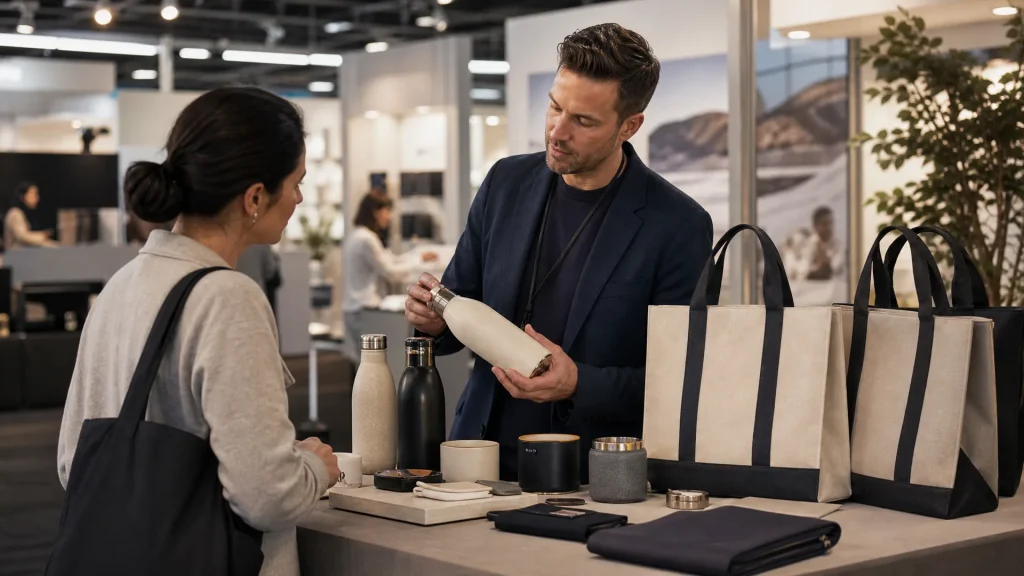
A well-planned trade show merchandise strategy is the difference between a booth people remember and one they walk past. Yet most exhibitors treat merch as an afterthought, a line item squeezed into the budget after stand design, travel, and registration fees have already been agreed. The result is a table full of generic branded pens that no one asked for and almost no one keeps. This article gives you a practical framework for choosing, distributing, and following up with promotional items that actually move the needle.
Why Most Trade Show Merchandise Misses the Mark
The most common mistake is picking products based on price per unit and habit, the same tote bags and stress balls as last year because they filled the booth and the budget allowed it.
The real cost of that approach is not just wasted spend. It is a missed conversation. Every giveaway is a proxy for your brand; a forgettable item signals a forgettable company. Worse, it wastes the most expensive thing you have at a show: the few seconds of attention from a genuinely interested prospect standing at your stand.
With over 25 years of branding experience, Abstract7 Creative Media Solutions (MerchGuru’s parent company) has found the same pattern repeatedly: items chosen to match a specific audience profile get kept and used, while generic giveaways rarely survive the trip home.
The fix is not spending more. It is thinking first. A focused trade show merchandise strategy starts before you open a single catalogue.
Start with Your Show Objective, Not Your Catalogue
Matching booth merchandise selection to your goal
Before you choose a product, answer one question: what is this show actually for?
- Lead generation, you need items that start a conversation and give a sales rep a reason to scan a badge.
- Brand awareness, you need high-visibility items that travel beyond the venue and keep your name in circulation.
- Product launch, you need merch that reflects the energy and positioning of what you’re launching, not your standard branded stock.
- Client retention, you need something premium that says “we value the relationship,” not something you’d hand to anyone who walks past.
The answer defines your product category, your unit cost tolerance, and how many items you actually need. Booth merchandise selection driven by a clear objective will always outperform selection driven by a catalogue browse.
Understanding how branded merchandise drives lasting event ROI is a useful starting point before you commit to a product direction.
Profiling your audience before you order anything
Who actually walks your floor matters as much as why you’re there.
Senior buyers making procurement decisions respond differently to giveaways than technical specifiers comparing product specs, or consumers trying something for the first time. A branded power bank lands well with a time-pressed executive who travels constantly. A seed kit or recycled-material notebook resonates with a sustainability-focused procurement team. A high-gloss gift box signals seriousness to a C-suite contact in a way a branded tote does not.
Spend ten minutes before you order anything writing down the two or three people most likely to visit your stand. What do they carry? What do they value? What does their desk look like? That profile is your brief.
Exhibition Giveaway Merchandise That Works Harder
Daily-use items that keep your brand in rotation
The clearest measure of a giveaway’s value is how often the recipient uses it after the show. Recipients are far more likely to remember a brand when the promotional item is something they use daily. Drinkware, notebooks, and tech accessories consistently outperform single-use items on recall and brand impression.
Drinkware is the most reliable category for daily-use recall. A quality insulated cup or reusable coffee cup sits on a desk or travels in a bag every working day. Every use is an impression, and unlike a digital ad, it is an impression the person chose to receive.
Tech accessories, cable organisers, portable chargers, wireless earbuds, earn desk space because they solve a problem. They get kept because they are useful, which means your brand is seen because it is useful.
Notebooks remain a strong performer at B2B shows. Senior buyers and creatives still take handwritten notes; a well-made notebook with subtle branding gets used through its natural life.
The impact from these categories compounds over time. One quality item used daily for six months outperforms 200 pens handed out at the door.
Eco-friendly and premium options for a quality-first impression
For audiences where values alignment matters, sustainability leads, ESG-focused procurement teams, or public sector buyers, eco-friendly promotional merchandise signals that you understand their priorities before you’ve said a word.
Recycled materials, bamboo, organic cotton, and seed-paper items all work in this space. The higher unit cost is justified because the item earns credibility that would otherwise take several conversations to build.
For VIP prospects or client retention moments, premium gift sets make the case for the relationship. Ready-to-brand gift sets built for VIP prospects do the heavy lifting here, curated, cohesive, and presented well enough to feel intentional rather than transactional.
How to Stand Out on the Show Floor
The most effective booth merchandise strategies are tiered. One item for everyone; a better item for the right people.
A broad traffic item, a branded reusable cup, a notebook, a useful tech accessory, gives your team a reason to engage anyone who slows down. It starts the conversation and creates goodwill at low cost per unit.
A premium item for qualified leads does something different. It signals investment in the relationship, it is memorable enough to sit on a desk rather than in a conference bag pile, and it gives your sales rep a natural handover line: “I’d love to send you our full pack after the show.”
A technology brand exhibiting at a B2B IT expo used exactly this approach: branded reusable coffee cups for general floor traffic, and a curated tech accessory set for qualified prospects. The premium tier sparked follow-up conversations that translated into three enterprise pipeline entries within two weeks of the show.
On-brand packaging matters more than most exhibitors expect. An item presented in clean, cohesive packaging with a handwritten card looks like a gift. The same item in a plain poly bag looks like merch. The difference in perceived value is significant, and it costs far less than upgrading the product itself.
The item should also prompt a story. Train your team to connect each giveaway to your brand’s value proposition in one sentence. “We made this from recycled ocean plastic, same thinking we bring to our supply chain work.” That sentence turns a notebook into a conversation.
Post-Show Activation: Turning Merch Into a Follow-Up Tool
Integrating trade show promotional items with lead follow-up
Most exhibitors do one thing with leads after the show: send a generic follow-up email into a cold inbox. Most of those emails are ignored.
The show merchandise follow-up approach works differently. Within five business days of the event, send a curated, personalised item to every qualified lead you scanned. Reference something specific from your conversation. Include a card with a direct next step.
A financial services firm that sent a personalised gift set to every qualified lead within five business days of a major Johannesburg expo found that email open rates on the follow-up sequence ran significantly higher than their standard cold outreach benchmarks. They attributed the lift to the physical touchpoint creating recognition before the email arrived.
That is the mechanism: the physical item arrives, the person remembers the conversation, and when the email follows, it lands in warm memory rather than a cold inbox. The show merchandise follow-up is a conversion tool, not a nice-to-have.
The CRM connection makes it strategic. Tag leads by tier at the show, record what premium item they received, and sequence your follow-up to reference both. A sales rep who says “I hope the tech kit arrived, I wanted to follow up on what we discussed about your Q3 rollout” is having a warmer conversation than one who sends a generic “great to meet you” email. Personalisation at this level signals that you listened, which is precisely what curated corporate gift ideas that travel well beyond the event are designed to do.
Building Your Trade Show Merchandise Strategy: A Quick Checklist
Use this before every show. It takes under 30 minutes and will save you from expensive guesswork.
- Objective confirmed, Lead generation, awareness, product launch, or retention? Written down, not assumed.
- Audience profiled, Two or three specific attendee types described. What do they value? What do they carry?
- Tier decided, Broad traffic item selected. Premium item for qualified leads identified. Quantities ordered to match expected lead volume, not stand footfall.
- Packaging planned, Presentation reviewed. Does it look intentional? Does it reflect your brand standard?
- Post-show item identified, The follow-up mailer or curated set is ready to ship before the show starts, not sourced after.
- Follow-up timeline mapped, Delivery window set (within five business days). Email sequence drafted and CRM tags agreed with the sales team.
- Story per item briefed, Your team knows one sentence connecting each item to your brand value proposition.
This is the framework that separates exhibitors who walk away with leads from those who walk away with leftover stock.
MerchGuru’s done-for-you sourcing service is built for time-pressed marketing and brand managers who need a strategic partner, not just a catalogue, when preparing for a major exhibition or conference. If your next show is on the calendar and you want a trade show merchandise strategy that covers product selection, tiering, packaging, and post-show activation in one place, get in touch with the MerchGuru team and we’ll build the brief with you.